

Two big pieces of news regarding the fight against AIDS: the commercialisation of the HIV self-test, and a study on the preventive use of Truvada to limit the risk of infection.
The HIV self-test
You may have already heard about it, but the news is worth highlighting and repeating: the HIV self-test is now available in France. The test, sold in pharmacies, is expected to cost between €25 and €30.

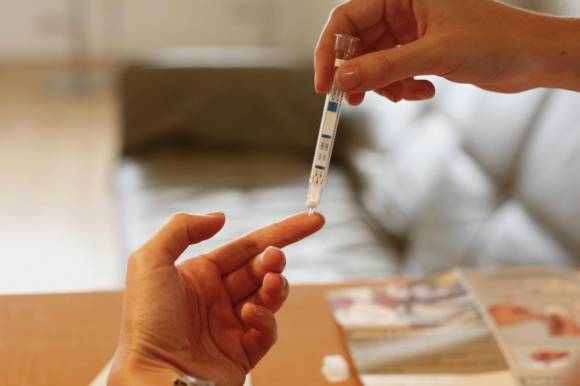
Photo explaining how to use the HIV self-test (Vice news)
The screening kit includes an “autopicker”, a small red cube with which you’ll need to prick the tip of your finger, previously washed and disinfected, to draw out a drop of blood. You then bring the end of the self-test, a sort of needle-less syringe, into contact with the drop. Then, you insert it into a holder containing a liquid. The result appears after 15 minutes.
However, a word of caution: the test is only reliable if the feared HIV exposure dates back more than 3 months, and it doesn’t replace a confirmation from a doctor or an accredited centre.
Ovidie points out on her blog that, although the idea might seem tempting at first, the self-test isn’t applicable to the porn industry. Indeed, its reliability window is longer than that of a blood test. Furthermore, it’s essential to test for all STIs, not just HIV.
The preventive use of Truvada appears effective
Truvada is an antiretroviral designed to fight the AIDS virus. Originally prescribed to HIV-positive people, its preventive use by HIV-negative people is now being studied. Indeed, taking this medication daily appears to reduce the risk of contracting HIV.
However, a recent study on the preventive effectiveness of Truvada produced results far better than expected. The study involved 657 volunteers, who took Truvada daily for two and a half years.

Truvada tablets (source: Wikimedia)
Naturally, the participants weren’t deliberately exposed to HIV. But they apparently had sufficiently high-risk practices that the expected rate of HIV infection was estimated at 8.9 cases per 100 people per year. The bottom line at the end of the study: all the guinea pigs remained HIV-negative.
Although they all escaped AIDS, the participants are not off the hook for all that. After 6 months, 30% of them had caught at least one STI, and that figure rose to 50% after a year. Which just goes to show that condoms are still a pretty good idea…
These promising results still need to be confirmed, however, as many factors come into play. Notably, the fact that the study was carried out in San Francisco, a city reporting a higher rate of HIV-positive people than the North American average, but also a higher rate of treatment. And treatment reduces the amount of virus in the blood, and therefore the risk of infecting others.

