

When it comes to the materials that make up the sextoys, relevant information is scarce and names are sometimes misleading. Hence the project Dildology, whose purpose is to sort fact from fiction in sextoys.

In fact, a sextoy that claims to be “made of silicone” can contain all sorts of filth with impunity if its official description does not specify that it is made of pure silicone. And to avoid regulation, some brands prefer to claim they sell “gadgets” (“novelties”) rather than sextoys.
But, thanks to the initiative of a few courageous bloggers, this may change soon. Dildology.org, an independent and unaffiliated website, offers to send sextoys to a lab to determine their actual composition.
Dildology: how it works and funding
The results of the analyses carried out by Dildology will all, without exception, be published in its wiki. Only one test is listed there at the moment: that of the vibrator JimmyJane Hello Touch, which, after analysis, turns out to be made of pure silicone, as stated in its official composition.
Checking the composition of a sextoy independently is expensive (between 200 and 450 dollars). To guarantee its impartiality, Dildology will have no advertising: its creators are relying on donations to complete their laborious project, whose motto is “In Dildo Veritas”.
Why it’s important to know the composition of sex toys
Toxic or allergenic materials
Some of the materials used are toxic, even carcinogenic. Others haven’t been subjected to any study of their long-term effects in a sex toy (because the object is sold, broadly speaking, with the label “this phallus-shaped vibrating gadget marketed in a sex shop is not a sex toy, don’t do stupid things like using it, for example”).
Some of the materials used are allergenic or irritating, or become so over time as they break down. I can give the example of a “jelly” dildo that, over time, developed a stinging taste (and no, I’ve never put any pepper on it). This happens because of the material’s porosity: when a porous sex toy ages, chemical compounds migrate from the inside to its surface and settle there.
Chemical reactions between sex toys
Bad sex toys fight each other and also attack good sex toys: unknown materials mean unknown chemical reactions.

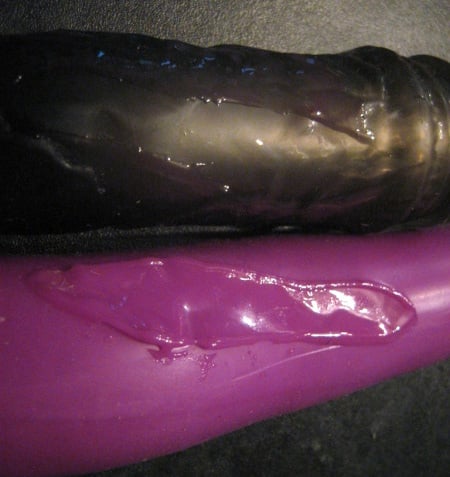
Result: some sex toys melt, and drip onto the others, wrecking them as they go. The carnage.
Doubts about material labelling
Saying a sex toy is made of silicone is supposed to be a sign of quality. When a sex toy that contains only a small percentage of silicone is sold as “made of silicone”, that’s a misleading description.
The sex toy’s smell
Well, you notice thesmell as soon as you unbox the sex toy. But buying a sex toy that looked attractive in a photo, and then being put off by a tyre-plastic smell to the point of no longer really wanting to use it once it arrives, is infuriating.
DIY methods for investigating
Sending the item to an independent lab is the only really reliable way to determine a product’s actual composition. However, there are also “DIY” methods for trying to guess what a sex toy is made of.
The sense of smell
A sex toy that stinks once unboxed is a bad sign. First, for your nose, which has to suffer this indignity. But also because it means the thing is leaking its molecules at every turn.
A sex toy made of pure silicone doesn’t smell bad. It might have a slight smell (not necessarily a bad one) if it has a coating. But if a sex toy irritates your nostrils when you take it out of its packaging, it is absolutely not pure silicone.
The flame test
This is already more delicate. In fact, you have to be prepared to sacrifice the sex toy to find out what it’s made of.
The “flame test” consists of placing the sex toy under a match or lighter flame, and observing its reaction. It’s best to make sure you have enough cold water nearby to avoid starting a fire. For example, a full wash basin.
DangerousLilly, one of the bloggers behind Dildology, uses sex toys whose material is known with certainty to establish the results you can expect from the test, depending on the composition. Some brands are so thoroughly tested by accredited bodies that there’s no doubt about them. This is especially the case with LELO, Tantus, We Vibe, Fun Factory, Je Joue and Jollies.
Generally, a pure silicone sex toy does not melt. It might burn (but the flame remains moderate) and produce ash. But once these residues are wiped off, the sex toy doesn’t become sticky; it retains its original texture. Whereas a sex toy that isn’t pure silicone melts, or burns like an oil lamp, with a stubborn flame that’s hard to extinguish.
This test may be indicative, but is not infallible. In fact, the JimmyJane Hello Touch, verified by Dildology.org, failed the “flame test”. But in the end, according to the lab, it turns out to be made of pure silicone. Hence the need to carry out an analysis.