
The STRASS, or the Union of Sex Workers, is a self-managed union, which brings together people engaging in paid work involving their own sexuality.
Last June, Najat Vallaud-Belkacem, Minister for Women’s Rights and Government Spokesperson, stated in an interview for the JDD her intention to to see prostitution disappear. She also recalled the adoption by Parliament in December 2011 of a resolution calling for the criminalisation of clients.
This announcement provoked strong discontent among the STRASS, which called for a demonstration, and among HIV prevention associations.

Indeed, the abolitionist measures, far from protecting sex workers, put them in danger, by making their working conditions harsher and further exposing them to the risks of assault and infection.
Manon, sex worker and spokesperson for the STRASS, agreed to answer my questions on this subject.
1 Regarding the 2003 law on passive solicitation:
“The fact of soliciting another person in public, by any means, including by a passive attitude, with a view to inciting them to sexual relations in exchange for payment or a promise of payment is punishable by two months’ imprisonment and a fine of 3 750 Euros.”.
It doesn’t even pretend to want to protect prostitutes, given that it directly targets them. The left promised to repeal this law, but currently, this no longer seems to be a government concern. Do you feel betrayed, or did you expect it?
Manon: In fact, we met with Najat Vallaud-Belkacem, who made it clear to us that the repeal of this law would not take place before the government looked into penalising clients !
So of course we are angry because François Hollande had promised it, but now, they are presenting it to us as “negotiation” ! Let’s say we have never had total confidence in the left, so betrayed, no, I think that for most of us, we had been expecting it.
2 As for the risks of assault, what have been the consequences of the 2003 law on passive soliciting? Do you think that lifting social taboos around prostitution could limit the risks faced by sex workers?
M: The consequences of the LSI (n.b.: the 2003 Internal Security Law, which, among other things, introduces the offence of “passive soliciting”) are numerous. First, there was an increase in the number of arrests (in the vast majority of cases, migrants, because this law is a purely anti-migrant law, not anti-pimping as it was presented… and this is how the government could produce this figure that 90% of prostitutes are migrants, this being based on these arrests), which further strengthened the mistrust among sex workers (n.b.: sex workers) towards the police.
It was already difficult to file a complaint for assault, the cops hardly ever listening to us (]“You just have to do a proper job”, “You’ve had it coming”, Why lodge a rape complaint when you’re having sex with anyone for money? At most, you could just call it theft since you haven’t been paid for the same service and other horrors are what you often hear when filing a complaint), the work of associations in supporting TDS with their cases has become almost impossible, especially as the cops were far more interested in the victim’s papers than in the attacker.
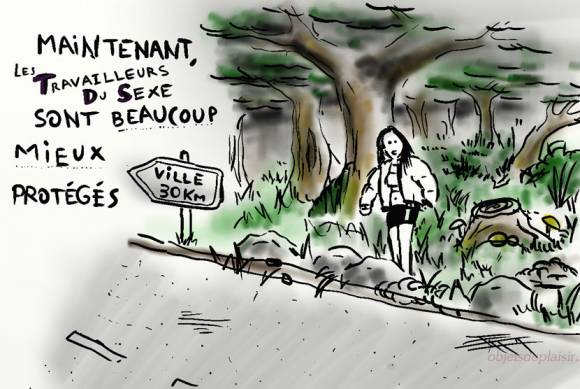
The second major negative point stems from this: to avoid being bothered by the cops, TDS have moved away from busy places, to set up in isolated places, away from associations, further from cities and therefore easier prey for attackers and rapists who know anyway that there is little chance that a TDS will lodge a complaint. There has been an rise in violence towards TDS.

3 About the correlation between the prohibition of prostitution and HIV and other STIs, if I understand correctly, the more we stigmatise sex workers and/or their clients, the more difficult it will be to raise awareness among both parties about prevention, because it will not be easy to talk to someone who is afraid to identify themselves for fear of being penalised. Is that your view? Do you have anything to add / correct?
M: The problem with prohibition is a bit like the second paragraph of my answer above: TDS move away, lie low and are not necessarily always aware of risky practices, or do not have access to protective and screening methods. This is why associations are important, they build trust with TDS who, in turn, do prevention work with new TDS.
Some TDS have moved online, making them less accessible to associations, which have for a few years had to develop branches “TDS online” to adapt their methods to this new form of prostitution.
Next, compared with the street, there needs to be a “negotiation” period between the client and the sex worker: prices, practices, condom use… This period also allows the sex worker to see if they “feel” the client, if the client is not too nervous, not drunk or on drugs… In short, everything that can help keep us safe. If the sex worker and the client feel stressed because the police can stop them at any moment, this time is shortened, and the sex worker does not necessarily have time to assess the client and can find themselves in danger (and therefore being raped, assaulted, kidnapped…)
In addition, fewer clients means lower income, so a sex worker who has had few clients, and who, like everyone else, really needs money to live, will more readily agree to fellations without a condom, for example if the only clients who come ask for it.
4 Regarding the laws on pimping, this article on the STRASS website explains very well how these laws have negative consequences for sex workers. However, I would like some clarification regarding the phrase “The paradox of these laws means that many sex workers turn to pimps so as not to be criminalised themselves”. Do you think it is the legal definition of the term “pimping” that needs to be reviewed?
M: In fact, with the soliciting law in France or laws making sex work more difficult in other countries, many have turned to intermediaries. For example, there are many French sex workers who go to work in brothels (so with bosses = pimps). I myself have been contacted many times by guys offering to find me clients in return for a fee (they find me clients, make sure the appointments go well and take a “commission” along the way).
There are also websites that were free before, but now charge (from 50 to over 1000 euros per month) to publish our ads. Some say they are taking risks under French law, so it is normal that they charge, others have simply realised that we had no choice but to pay if we wanted to work properly.
You can also pay concierges to give out our number, pay more to hoteliers to avoid hassle… In short, at present, nothing is being done to keep us independent.
Next, It is necessary to revise the definition of pimping because it’s a catch-all : the husband with no income of his own (is that asked of a woman who has another job and helps her partner when he needs it?), the person who looks out for us on the street, checking which car we get into, how long we take, and making sure everything is okay, or the person we message to tell them where we’re going, with whom, and for how long, the person who gives us a lift to an appointment when our car breaks down, the person who lends/lets us a place (a van, business premises, an apartment, a house, a hotel room…), the hotelier who lets us work in his rooms, our children when they are adults, anyone we’ve helped out by lending a little money, the friend you share advice with about appointments, practices, safety… Right up to real pimping, the kind everyone knows about.
Of course, we are against that last form! But the rest is pure hypocrisy! They isolate us, and then they come to us about pimps and the dangers of this profession, but it’s them who do everything to make it happen like that!

5 In your view, what legal measures should be taken to allow you to optimise working conditions?
M: They should give us the right any other worker has: to work where we want (renting hotel rooms, working in an apartment or house, a van… alone or in a group), and have the same social security rights (pension, contributions…).
But they should also allow us to advertise ourselves without being forced to use paid foreign websites. Revise the definition of pimping so that they stop picking on our colleagues, friends, families, spouses… Take our complaints into account (how do you fight pimps when you refuse to listen to sex workers who come to report violence, detention, rape…?)
We should also protect victims of trafficking networks by allowing them to stay in France, to have access to training, justice and healthcare.
6 Brothels (at least, as they are found in the Netherlands, Germany or Spain) do not seem to be an ideal workplace (given that exploitation seems to be present there). Do you think that, despite everything, allowing such establishments to exist is a preferable solution to abolitionism?
In your opinion, how could we guarantee the independence of sex workers (or at least the absence of exploitation), while allowing them to collaborate with one another (as with any other type of trade)? Through associations, perhaps?
M: We are against brothels, as I mentioned a little earlier we just want to be able to team up and work together in flats, houses… without bosses, hours/clients/practices/
In Spain, brothels operate on a hotel model (renting a room in an establishment), but we would like to be able to simply rent a room in a hotel without a boss timing how long we take!
We don’t need to be shut away in special places out of sight, because what we do is so dirty that we shouldn’t be mixed in with the rest of the population!
There are establishments that require or strongly encourage fellatio without a condom… I don’t want my health to be played with just so my boss can make more cash!
7 I imagine that sex workers who campaign are among those who work for themselves, setting their own terms (but perhaps I am wrong). How can you be sure that those who work in more difficult conditions share your view?
M: Some of us work on the street and we are also in contact with many community health organisations that work on the ground (street and online), so we are aware of the working conditions of some people, and we fight for them too. We fight for their police complaints to be heard, for them to be recognised as victims and for them to be able to access papers, to training… (what I said above)
We fight so that we stop spreading ourselves thin over nonsense (passive soliciting, aid and support pimping, off-the-books work…) and for the police to actually take an interest in pimping networks. Listening to victims rather than focusing on their papers would already be a good start.
It is not by penalising clients or persecuting us that we can help trafficking victims, because they will be forced to work in worse conditions: hidden, far from support structures…
8 Do you think the profession of a sex worker could, in some cases, be brought closer to the medical field (given that you contribute to the wellbeing of your clients)? To the artistic field (on the same footing, for example, as that of a stripper)?
M: Being a nurse myself, I find many similarities between the medical field and sex work. You have to be able to get a handle on a person fairly quickly, by seeing them for a few seconds or by having them on the phone. You have to know what brings the person. I have noticed that sex is often an excuse for an appointment, many, before or after, talk to me about their problems, their life, their worries… and you have to to be a good enough listener and to question the person tactfully so that they feel free to talk to a perfect stranger. You have to have patience, know how to deal with disabilities : physical disability, illness, or simply problems with erection, premature ejaculation, morbid shyness…
I know I have many widowers who come to me for female company without feeling like they are being unfaithful to their late wife; I am usually the first woman they touch again after 1, 2 years, or even more!
But you also need a lot of humour to turn any situation into a laugh and to de-dramatise (whether it is for them or for us).
And of course, there is also the artistic field, whether it is for strip-teasing, photography… And even I find it fun to get ready for my clients, a bit as if I were going on stage: putting on makeup, putting on nice lingerie, a pretty dress, heels… Or using imagination to surprise a regular! There is also a game of seduction that I set up, knowing how to excite my one-night partner, but I can also be myself, in all simplicity, be very seductive, or the girlfriend… In fact, we put on several roles depending on our moods and our clients.
After all, we don’t all work the same way…
Thank you again, Manon, for taking the time to answer these questions.